
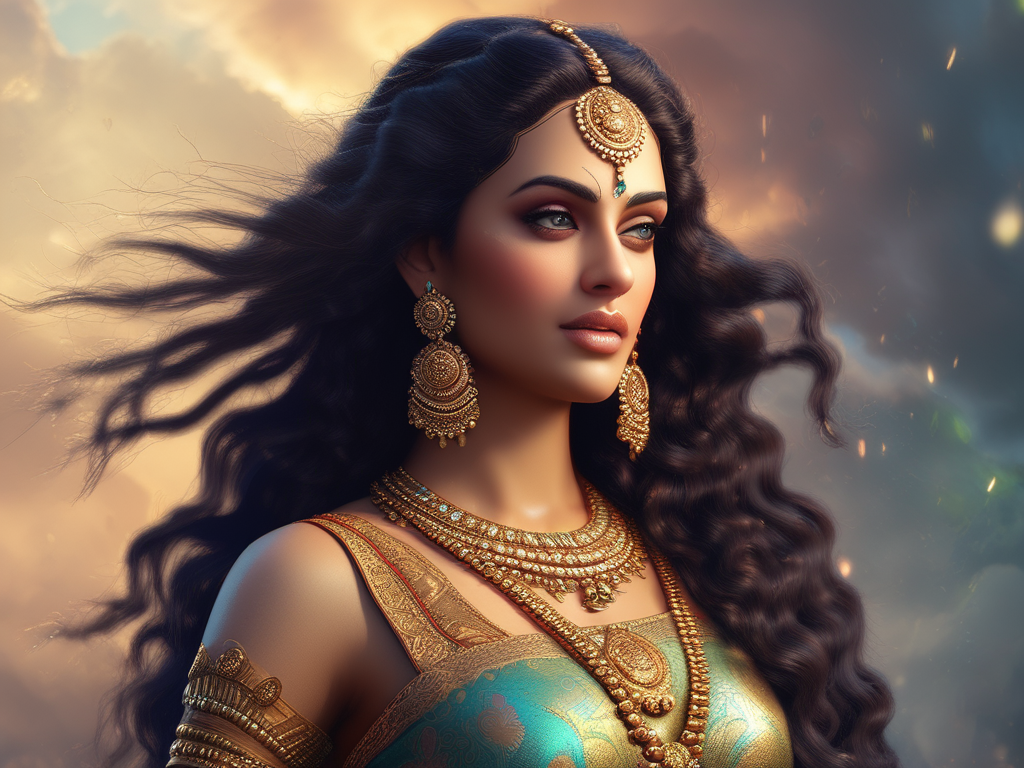
பொருந்திய முப்புரை! செப்புரை செய்யும் புணர்முலையால்
வருந்திய வஞ்சி மருங்குல் மனோன்மணி! வார்சடையோன்
அருந்திய நஞ்சு அமுதாக்கிய அம்பிகை! அம்புயமேல்
திருந்திய சுந்தரி அந்தரி பாதம்என் சென்னியதே.
Pŏrundiya muppurai! Śĕppurai śĕyyum puṇarmulaiyāl
Varundiya vañji maruṅgul manonmaṇi! Vārsaḍaiyon
Arundiya nañju amudākkiya ambigai! Ambuyamel
Tirundiya śundari andari pādamĕn śĕnniyade.
Translation: She is established in Tripurā. Has bosoms that defy/define the tensile strength of copper. Her slender waist is burdened by the heaviness of her bosoms. She is known by the name Manonmanī. The poison drunk by the lord who has matter hair as his crown was converted into nectar by her. She is the one who is seated on the lotus as a beautiful woman. She stands in the sky without any support and it’s her feet I have on my head.
Pŏrundiya – Completely fit in muppurai – Tripurā / three worlds. This nomenclature has multiple interpretations, starting with Puranas, Sakta philosophy, and Vedanta. Let’s go over each of those and the significance to them in this verse. The asuras tormented the worlds with their flying castles, which were also named Tripurā. Lord Śiva was approached by the celestial beings to vanquish the asuras so that the order was set back in the worlds. Lord Śiva goes to the battle alone, making the sun and moon the wheels of a chariot, Vasuki the celestial snake as the bowstring, and Mount Meru as his bow. He left for the battle just with one arrow in a quiver and the arrow was none other than Narayana. On the battlefield, Lord Śiva destroyed the Tripurā of the asuras just with a smile and the single arrow that he carried. This form of Lord Śiva is called Tripurā Samhara Moorthy and his consort is called Tripurā.
Tripurā also means all triads in existence. The most common triad is the three states of existence. They are states of being awake, dreaming, and deep sleep. These are the normal three states that men experience. However, beyond these states exists Turiya. Śiva Sutra 1.7 states Jāgratsvapnasuṣuptabhede turyābhogasambhavaḥ. From the commentary of Shri Ravi Guruji, it is clear that the Turiya state exists even during all the other three states of existence, however, this state is not experienced by most of the men until quality meditation happens. As Devi is the embodiment of Maya as well, she exists in all three states of existence and also in the final state of Turiya. Hence she is called Tripurā.
The term Tripurā also denotes the existence of the three bodies viz gross, subtle, and causal bodies. Śakti due to her existence in all three layers and being the force behind the existence of the three bodies, is called Tripurā.
In the Śrīcakrā the Śakti’s of Lalithā exists as Mahā kāmeśvarī, Mahā vajreśvarī and Mahā bhaghamālini responsible for creation, sustenance, and destruction respectively. Lalithā being the embodiment of all three Śakti here, she is known as Tripurā. Tirumantiram verse 401 states
அளியார் முக்கோணம் வயிந்தவந் தன்னில்
அளியார் திரிபுரை யாமவள் தானே
அளியார் சதாசிவ மாகி அமைவாள்
அளியார் கருமங்கள் ஐந்துசெய் வாளே.
Translation:
From Bindu by Orderly triangle denoted
The honeyed Śakti Tripurāi devoluted;
She it is the Compassionate SadaŚiva
Became
She it is the five merciful deeds performs
Author’s Translation: From the Bindu, emerges the triangle. The one who is embodied in the Bindu triangle is Tripurā. She becomes the SadaŚiva or She is seated on SadaŚiva and does the five actions i.e. creation, sustenance, destruction, illusion, and benefaction. This further elucidates, as Śakti from Bindu, the triangle forms and this is the triangle that houses the three Śakti from Mahā kāmeśvarī. As she is the cause of this triangle, she is called Tripurā. Lalithā sahasranāmam also refers this attribute as Trikoṇāntara-dīpikā त्रिकोणान्तर–दीपिका (597)
On the individual level, the karmas one accrues are categorized into three i.e. Sañcita, Prārarbdha, and Āgamiyaṁ. Devi is the one who manages the Karmic accounts and is responsible for their timely delivery. She being the controller of the cycle of life as Bhava-cakra-pravartinī भव–चक्र–प्रवर्तिनी (843) she delivers the results of karma to the individuals. As Maya, she administers the three types of Karma and hence she is also called Tripurā.
As she is the cause and present in all triads of existence viz. morning-noon and night, three gunas satva-rajo and tamo, knower-knowledge and known, etc., Devi is known as Tripurā.
Lalithā sahasranāmam speaks about the triads of Devi in the names.
Tripurā त्रिपुरा (626), Trijagad vandyā त्रिजगद् वन्द्या (627), Trimurtiḥ त्रिमुर्तिः (628), Tridaśeśvarī त्रिदशेश्वरी (629), Tryakṣarī त्र्यक्षरी (630) She is the head of three cities, worshipped by people of three worlds, she carries out the actions of the holy trinity Brahma, Vishnu and Rudra, she is the Śakti of the trinity and she has three aksharas as her mantra aim-kleem-sauh and also the Pranava Aum with syllables A-U-Ma.
Her bodily description in sahasranāmam also is done in three stages i.e. from head to neck, neck to waist, and waist to toe, denoting her mantra is Trikūṭā त्रिकूटा (588)
Śĕppurai śĕyyum puṇarmulaiyāl – Her bosoms are firm as that of copper / She defines the existence of all the creation / She nurtures the creation with her bosoms.
Lalithā Trisati states that her bosoms are firm and circular in the nama kaṭhinastanamaṇḍalā कठिनस्तनमण्डला. With her bosoms she nurtures the entire creation, this can also be supported by her supreme Pañcadasi mantra, where the second kuta ha-sa-ka-ha-la-hreem stands for sustenance, and as sustenance is the most difficult act, this kuta of the mantra is lengthier than other two kutas of the mantra. This is one reason that most of the stotras keep referring to her bosoms in many places just that they are awed by her capability and mercy as she nurtures and sustains the universe.
Varundiya vañji maruṅgul – Her slender waist is burdened due to the heaviness of her bosoms
Tirumantiram verse 402 also refers this as follows:
வாரணி கொங்கை மனோன்மணி மங்கலி
காரணி காரிய மாகக் கலந்தவள்
வாரணி ஆரணி வானவர் மோகினி
பூரணி .(1).போதாதி போதமு மாமே.
Translation:
She is Manonmani, the ample-bosomed;
Mangali, the ever auspicious;
Varani of elephant form
Arani of haunting forests
Mohini of tempting beauty
Poorani–the Perfect Being,
Cause-Effect conjoint in one
Source: https://www.bhagavadgitausa.com/TirumantiramTamil-EnglishAll.htm
Author’s Translation: The one who has bosoms tied with a belt, she is known as Manonmanī, ever auspicious, embodied in the cause and its action. In the form of an elephant, dwelling in the forests, seduces the beings of the sky. One who is a completely perfect being and she is the ultimate knowledge.
From Ravi Guruji’s commentary on Manonmanī मनोन्मनी (207). It is understood that when triads dissolve and the aspirant is ready for the merger, the stage is called manonmana. She is also called as Manonmanī as she is beyond perception of thoughts and actions.
Vārsaḍaiyon Arundiya nañju amudākkiya ambigai! – She converted the poison into nectar, which was drunk by Lord Śiva. The act of sustenance is repeatedly referred to in this verse, even when Lord Śiva drank the poison, Devi converts that into nectar and averts further catastrophe. This is another reason to refer to her bosoms in this verse, as it denotes protection and sustenance of all of existence. As Śiva represents all of existence, she protects him from poison, otherwise, the entire creation will plunge into deeper darkness. Soundarya lahari verse 28 states that Śiva was protected from the poison merely due to the glory of her tāṭaṅka
Ambuyamel – on the lotus Tirundiya – with discipline śundari – Devi/beautiful lady andari – one who is in the sky pādamĕn śĕnniyade. – your feet are on my head.
Bhattar exclaims the mercy of Devi who sits on the lotus and who pervades the sky, has placed her feet on his head. In the Saiva philosophy, the act of blessing a disciple by the guru is done by placing the guru’s feet on the disciple’s head, which is known in Tamil as “Thiruvaḍi dīkṣā”. It is believed that Lord Śiva provided this Deeksha to Manickavasagar and a few other nayanmar. Similarly, as Devi is the ultimate Guru, as she is the one who can provide the ultimate knowledge, her feet are ever placed on the feet of Bhattar as he always contemplates the ultimate knowledge or supreme consciousness which is none other than Devi.
In another interpretation, if the lotus mentioned in the verse are considered as the major chakras of the body, Devi is the one who aligns it and with a disciplined meditation on the chakras, she as Antari provides the knowledge of Śiva in the dwadasantha space which is twelve inches above one’s head. As she is above the head and pervading the space, she is also called Antari. Disciplining chakras is nothing but clearing the blockages to make the free flow of the primordial kundalini Śakti in the body. Bhattar also refers to the kundalini meditation practice in this verse.
The word lotus is also specifically used to denote the heart chakra or the seat of atman, subtly conveying the contemplation of the heart chakra that will eventually lead to the emancipation of one’s soul with the grace of Śakti.
 Abirami Samayam